Concrete Quality Checks on Delivery: What to Verify When the Truck Arrives
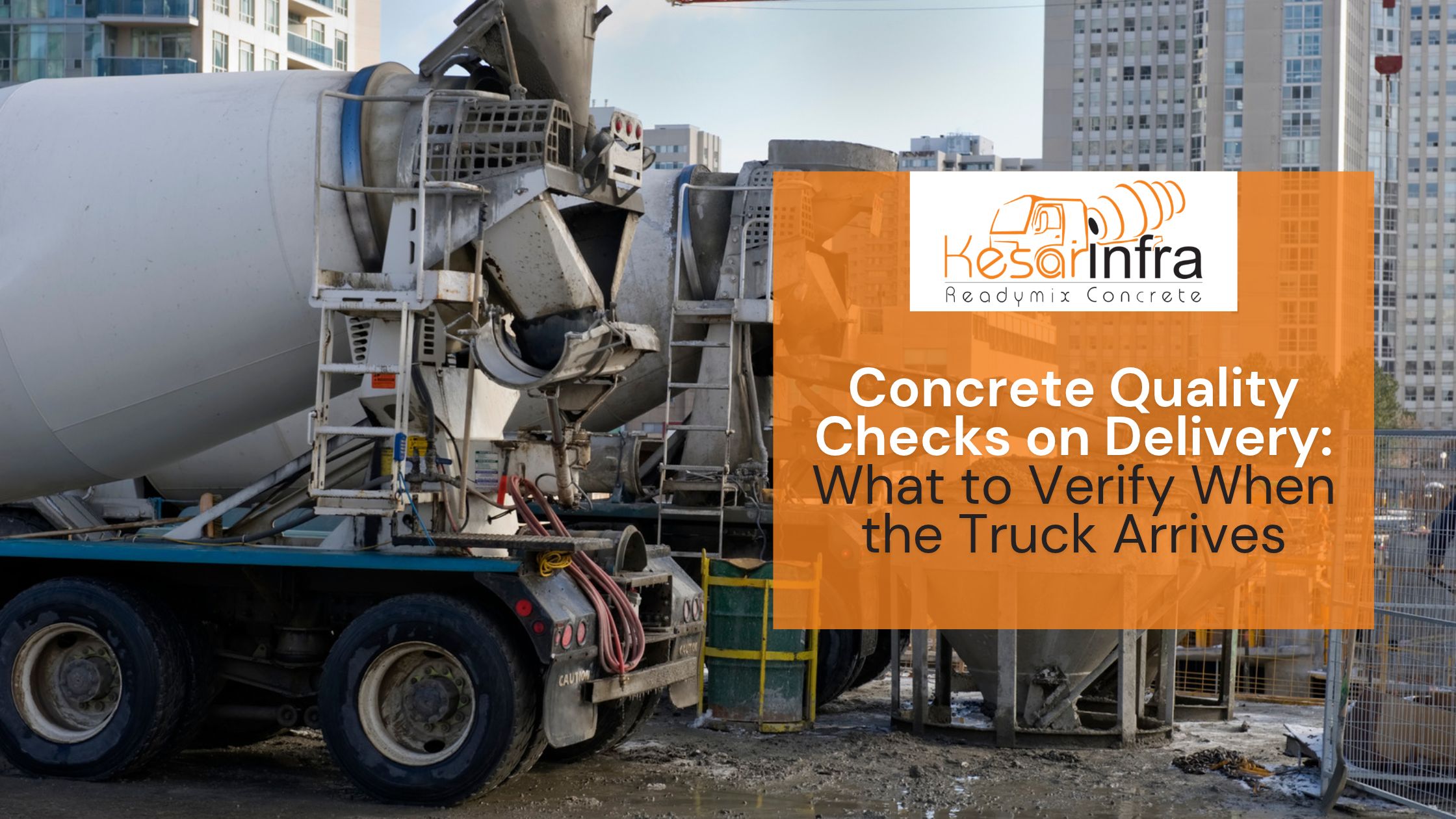
When a ready-mix concrete (RMC) truck arrives at a construction site, checking the concrete before unloading is an important part of quality control. Even when concrete is produced at a batching plant according to an approved mix design, site teams must verify that the delivered material matches the project requirements.
A few basic checks can help identify discrepancies in the delivery details, concrete consistency, and workability before placement begins. For contractors, civil engineers, and site supervisors, knowing what to inspect can help prevent avoidable construction problems.
This guide explains the essential concrete quality checks to perform when an RMC truck arrives, including delivery challan verification, slump testing, sampling, and handling unexpected results.
Why Are Concrete Quality Checks Important at Delivery?
Concrete quality checks help confirm that the delivered mix is suitable for the intended construction work and complies with the approved project specifications.
Checking concrete at delivery is important because it helps site teams:
- Verify the concrete grade and ordered quantity.
- Identify differences between the order and delivery details.
- Assess the consistency and workability of fresh concrete.
- Arrange required sampling and testing.
- Identify potential issues before concrete placement.
These checks are especially important for structural applications such as foundations, columns, beams, and slabs, where concrete must meet specified requirements.
What Should You Check Before Unloading an RMC Truck?
Before unloading, the site supervisor should carry out a basic inspection of the delivery and the fresh concrete.
Here are the important points to verify:
- Concrete grade: Check whether the delivered grade matches the approved order and structural requirements.
- Quantity: Confirm the supplied volume against the delivery challan and purchase order.
- Delivery time: Note the batching and arrival details to help assess the elapsed time.
- Mix requirements: Verify the specified mix or concrete type for the intended application.
- Visual consistency: Observe whether the concrete appears reasonably uniform and whether there are obvious signs of segregation.
- Site readiness: Ensure the formwork, reinforcement, access route, labour, and placing equipment are ready.
Visual inspection is only an initial check. It cannot independently establish concrete strength or confirm that the mix meets every specification.
How to Verify Concrete Delivery Details at the Site?
The delivery challan is an important document that accompanies an RMC delivery. It provides information that helps the receiving team compare the supplied concrete with the order.
Depending on the supplier's documentation and project requirements, check:
- Supplier and batching plant details.
- Delivery challan or batch reference number.
- Concrete grade and mix designation.
- Quantity supplied.
- Batching or dispatch time.
- Site or project identification.
- Any specified mix or admixture details.
If any important detail is missing or does not match the order, clarify it with the supplier before accepting the delivery.
How to Check Fresh Concrete Workability?
Workability describes how easily fresh concrete can be mixed, transported, placed, compacted, and finished without losing its uniformity.
Concrete that is too stiff may be difficult to place around reinforcement. On the other hand, concrete that is excessively fluid or unstable may show segregation or bleeding.
Workability should be assessed using the tests and acceptance criteria specified for the project. Site personnel should not rely only on appearance or touch to decide whether concrete is acceptable.
What Is a Concrete Slump Test and Why Is It Important?
A concrete slump test is a field test used to assess the consistency of fresh concrete. It measures how much concrete subsides after a standard cone-shaped mould is lifted.
The general test procedure involves filling the slump cone with concrete in prescribed layers, compacting each layer as required, lifting the cone vertically, and measuring the resulting subsidence.
The result is expressed in millimetres and compared with the approved slump range for the mix.
A slump test is useful for identifying differences in workability, but it does not measure compressive strength. The appropriate slump depends on the concrete mix design, placement method, and project specifications.
How to Check Concrete for Segregation and Bleeding?
Two visible conditions that site teams should watch for are segregation and bleeding.
Segregation occurs when concrete ingredients separate instead of remaining uniformly distributed. For example, coarse aggregates may separate from the cement paste and mortar.
Bleeding occurs when water rises towards the surface of freshly placed concrete as solid particles settle.
Excessive segregation or bleeding can affect concrete uniformity, surface finish, and performance. If either condition is suspected, inform the responsible engineer and follow the project's inspection and acceptance procedure.
Why Is Sampling Important During Concrete Delivery?
Fresh concrete sampling allows test specimens to be prepared for evaluating properties such as compressive strength.
Samples should be collected at the stage, frequency, and in the manner required by the applicable standards and project quality plan. The sampling process should represent the concrete being supplied and should avoid contamination or improper handling.
Concrete specimens are then prepared, cured, and tested at the specified ages by the designated testing facility or laboratory.
Remember that a slump test and a compressive strength test serve different purposes. Both may be required as part of a project's quality-control process.
What Documents Should You Check When RMC Arrives?
Apart from the delivery challan, the project team may need to verify other quality-related records, depending on the contract and project requirements.
These may include:
- Approved concrete mix design.
- Relevant material or quality-control test records.
- Delivery and batch details.
- Slump test records.
- Concrete sampling and cube test records.
- Any project-specific inspection or acceptance documentation.
Maintaining these records helps track concrete deliveries and supports quality documentation throughout construction.
What Should You Do If Delivered Concrete Does Not Meet Specifications?
If the concrete grade, slump, appearance, documentation, or another acceptance parameter does not match the project requirements, do not ignore the difference.
The site supervisor should:
- Pause unloading or placement if an acceptance concern exists.
- Record the delivery and inspection details.
- Inform the responsible site engineer and RMC supplier.
- Conduct any required repeat test or additional inspection according to the applicable procedure.
- Follow the engineer's decision and the project's acceptance or rejection process.
Avoid adding water at the site to change the slump without authorization. Uncontrolled water addition can alter the water-cement ratio and affect concrete performance.
Common Mistakes to Avoid During Concrete Delivery Inspection
Some common mistakes can reduce the effectiveness of site quality checks:
- Unloading concrete without checking the delivery challan.
- Ignoring the specified slump range.
- Judging concrete quality only by its appearance.
- Adding water without approval.
- Delaying required sampling and testing.
- Failing to record delivery and inspection details.
- Continuing placement despite unresolved quality concerns.
A consistent inspection process helps site teams identify issues early and make decisions based on project specifications rather than assumptions.
Why Choose Kesar Infra for Ready-Mix Concrete in Vapi?
Kesar Infra supplies ready-mix concrete for construction projects in Vapi and nearby areas of South Gujarat. The company serves different construction requirements with concrete supply operations across locations including Vapi, Umbergaon, Dahej, and Silvassa.
For your next concrete order, discuss the required grade, quantity, application, workability requirements, site location, and delivery schedule with the Kesar Infra team.
Clear communication before dispatch helps align the supply with site requirements and makes it easier for contractors to plan concrete placement and inspection activities.
Conclusion
Concrete quality checks at delivery are an essential step in managing construction quality. Verifying the delivery challan, concrete grade, quantity, workability, slump, and required test records helps site teams assess whether the supplied material meets project specifications.
For construction projects in Vapi and nearby areas, proper coordination between the RMC supplier and site team is equally important. Contact Kesar Infra to discuss your ready-mix concrete requirements and plan your next delivery.
Frequently Asked Questions
1. What quality checks should be performed when an RMC truck arrives?
Check the concrete grade, quantity, delivery challan, batching details, visual consistency, and specified slump. Carry out required sampling and testing according to the project quality plan.
2. How do you check the quality of ready-mix concrete at the site?
Site teams can verify delivery documents, conduct a slump test, inspect fresh concrete for visible signs of segregation or bleeding, and arrange compressive strength testing using properly prepared specimens.
3. Why is slump testing important during concrete delivery?
Slump testing helps assess the consistency and workability of fresh concrete and compare the result with the approved project requirements.
4. What should be checked on an RMC delivery challan?
Check the concrete grade, quantity, batching or dispatch time, supplier details, batch reference, and other mix information required by the project.
5. What should you do if delivered concrete fails the required slump test?
Inform the responsible engineer and supplier, document the result, and follow the project's acceptance procedure. Do not make unauthorized changes to the concrete mix.
6. Can water be added to ready-mix concrete at the construction site?
Water should not be added without authorization. Any permitted adjustment must follow the approved mix design, applicable specifications, and the responsible engineer's instructions.