Why Transit-Mixed RMC Beats Site-Mixed Concrete for Industrial Projects
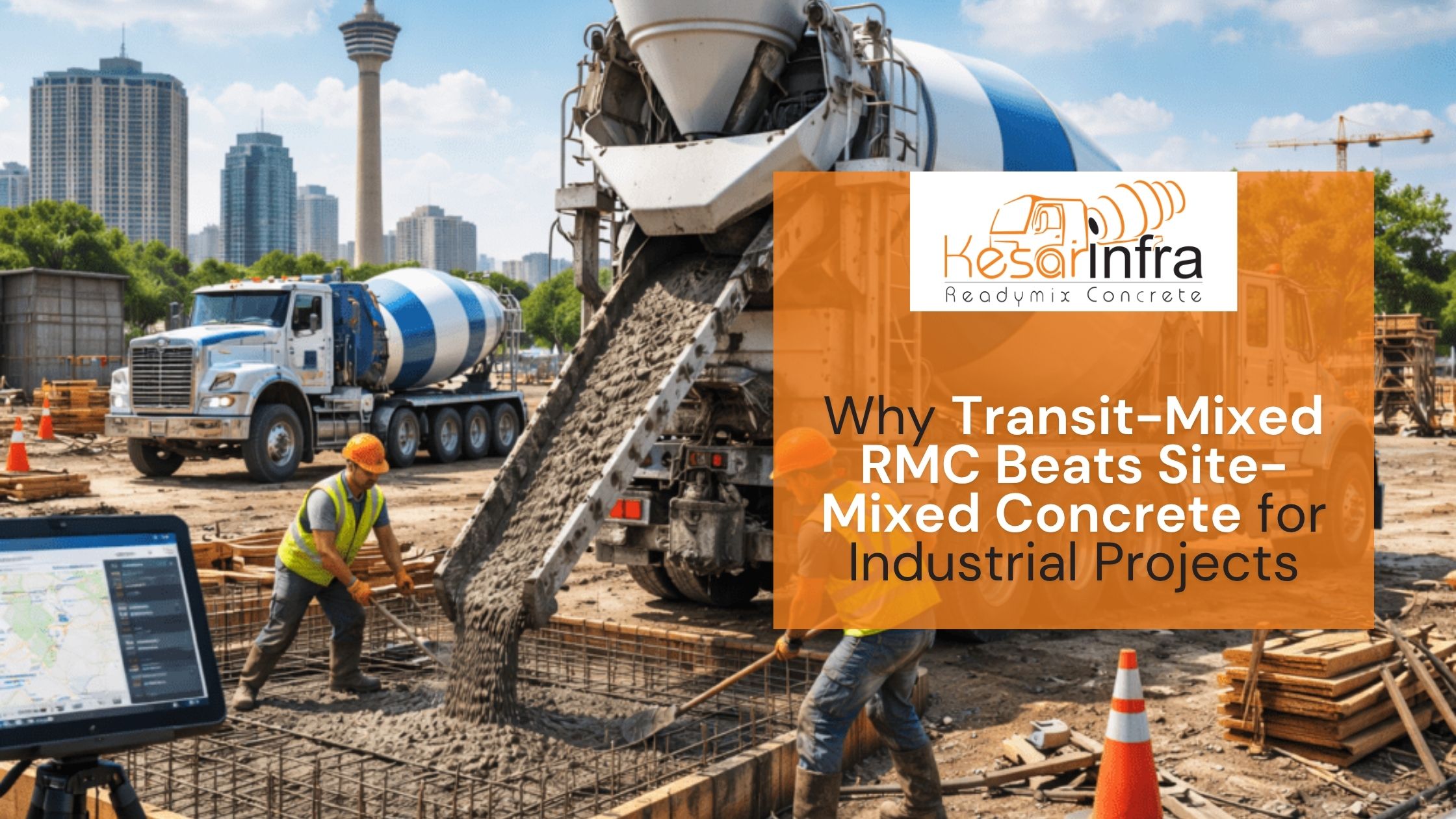
Industrial construction projects require concrete that can meet demanding schedules, maintain consistent quality, and arrive at the site when it is needed. Whether the project involves factory foundations, industrial flooring, warehouses, structural elements, or large concrete pours, the method used to produce and deliver concrete can affect overall project efficiency.
Transit-mixed RMC offers a practical alternative to manually prepared concrete at the construction site. It combines controlled batching at an RMC concrete plant with transportation in transit mixer trucks, allowing concrete to reach the project site ready for placement.
For industrial projects in Gujarat, working with an experienced RMC supplier can help contractors coordinate concrete supply with their construction schedule while reducing some of the challenges associated with site mixing.
What Is Transit-Mixed RMC?
Transit-mixed RMC, or ready-mix concrete, is concrete produced using measured quantities of cement, aggregates, water and other required materials according to a specified mix design. The concrete is then transported from the RMC concrete plant to the construction site using transit mixer trucks.
Unlike site mixing, where materials are measured and mixed at the project location, RMC production takes place in a controlled plant environment.
The basic ready mix concrete manufacturing process generally involves:
- Selection and proportioning of raw materials.
- Batching of materials according to the required mix.
- Mixing to achieve the required concrete consistency.
- Loading the concrete into transit mixers.
- Transportation to the construction site.
- Placement using suitable site equipment.
This process allows contractors to plan concrete requirements around specific construction activities and pouring schedules.
Transit-Mixed RMC vs Site-Mixed Concrete
The main difference between transit-mixed RMC and manually mixed concrete is where and how the concrete is produced.
|
Factor |
Transit-Mixed RMC |
Site-Mixed Concrete |
|
Production |
Produced at an RMC plant |
Produced at the construction site |
|
Batching |
Controlled batching system |
Materials generally measured at site |
|
Quality consistency |
More consistent when production is properly controlled |
Can vary with site conditions and handling |
|
Labour |
Requires less on-site mixing labour |
Requires labour for measuring and mixing |
|
Storage |
Less need for on-site raw-material storage |
Requires storage of cement and aggregates |
|
Large pours |
Suitable for planned, continuous supply |
More difficult to coordinate for high-volume pours |
|
Site space |
Mixing area is not required |
Space is needed for mixing and material handling |
|
Scheduling |
Supply can be coordinated with project requirements |
Production depends more heavily on site operations |
The choice ultimately depends on project size, location, concrete requirements, available resources and construction timelines. For many industrial applications, the controlled production and planned delivery of RMC can simplify concrete operations.
Why Industrial Projects Prefer Transit-Mixed RMC
Industrial projects often involve multiple construction activities taking place simultaneously. Foundations, columns, slabs, equipment bases, flooring and other structural elements may require concrete at different stages of the project.
Using RMC in construction can make concrete supply easier to coordinate because production takes place at a dedicated plant rather than relying entirely on mixing operations at the project site.
For larger projects, this can be particularly useful when several concrete deliveries need to be scheduled around reinforcement, formwork, pumping and placement activities.
Transit-mixed RMC can also help reduce the amount of material-handling work required at the construction site, leaving more space for other project activities.
Key Advantages of Transit-Mixed RMC for Industrial Construction
1. Consistent Batching
One of the important advantages of RMC is controlled proportioning of materials. Consistent batching helps contractors receive concrete produced according to the specified mix requirements.
2. Better Site Organisation
Site mixing requires areas for cement, aggregates, water and mixing equipment. With RMC, concrete is produced at the plant and transported to the project, reducing the need to dedicate significant site space to concrete production.
3. Reduced Mixing Labour
Manual concrete production requires workers to measure, handle and mix materials. Transit-mixed RMC shifts much of this work to the RMC plant, which can reduce the mixing-related workload at the construction site.
4. Suitable for Planned Concrete Pours
Industrial projects can involve substantial concrete quantities. RMC deliveries can be scheduled according to the planned pouring sequence, helping contractors coordinate concrete arrival with site preparation and placement.
5. Less Material Handling at Site
Moving cement, aggregates and other materials around an active industrial construction site can add to site congestion. RMC reduces the need for these materials to be processed into concrete at the project location.
How Transit-Mixed RMC Supports Large Concrete Pours
Large concrete pours require coordination between concrete production, transportation, pumping and placement.
A typical RMC supply cycle involves production at the plant, loading into transit mixers, transportation to the project and discharge at the required location. When deliveries are planned properly, multiple mixer trips can support the progress of a large pour.
For industrial construction, this coordination becomes important for applications such as foundations, slabs, equipment bases and other high-volume concrete works.
The exact delivery schedule depends on factors such as concrete quantity, project location, traffic, site access, placement rate and available transportation equipment.
Quality Control in Transit-Mixed RMC
Quality is an important consideration when selecting an RMC supplier. The manufacturing of RMC should follow a controlled process covering material selection, batching, mixing and delivery.
Contractors should discuss the required concrete grade, mix requirements, quantity and application with their RMC supplier before placing an order. Proper communication between the plant and construction team is particularly important for large industrial pours.
A professional supplier should also be able to provide information about the concrete being supplied and coordinate deliveries according to the project's requirements.
Cost & Time Benefits for Industrial Projects
The rate of RMC concrete is only one part of the overall cost calculation. Contractors should also consider labour, material handling, site preparation, wastage, equipment and construction time.
Site mixing may appear straightforward for smaller quantities, but larger projects can require substantial labour and space for material storage and mixing.
With RMC, concrete production is handled at a dedicated plant and delivered to the site. This can help streamline concrete operations and reduce some site-level activities associated with manual mixing.
The actual cost advantage depends on project size, concrete grade, order quantity, transportation distance, pumping requirements and prevailing material and labour costs.
Industrial Projects Served by Kesar Infra
Kesar Infra supplies ready-mix concrete for construction requirements across industrial and infrastructure locations in Gujarat. RMC can be used for a range of applications, including:
- Industrial buildings and factory structures
- Manufacturing facilities
- Warehouses and logistics facilities
- Industrial flooring
- Foundations and structural elements
- Commercial-industrial developments
- Infrastructure and road-related construction
For projects requiring regular concrete deliveries, choosing an RMC supplier with suitable plant and transportation capabilities can help contractors coordinate their concrete requirements more efficiently.
Why Choose Kesar Infra for Transit-Mixed RMC?
Kesar Infra is an RMC manufacturer and supplier based in Vapi, Gujarat, serving construction requirements across South Gujarat and nearby industrial areas.
The company operates RMC plants in locations including Vapi, Umbergaon, Dahej and Silvassa, helping support concrete supply across industrial regions. Kesar Infra also has transit mixers and concrete placement equipment for project requirements.
For industrial contractors, the key consideration is not simply obtaining concrete but coordinating production, transportation and placement according to the project schedule.
Kesar Infra focuses on concrete supply with planned delivery, quality-oriented production and equipment support for different construction requirements.
Kesar Infra's Industrial Project Coverage
Kesar Infra serves construction and industrial requirements in and around areas such as Vapi, Valsad, Umbergaon, Sarigam, Silvassa, Dahej, Navsari and nearby regions of South Gujarat.
Local plant availability and delivery distance can be important factors when selecting an RMC supplier because concrete transportation needs to be coordinated with the project's pouring requirements.
For larger industrial projects, contractors can discuss the required concrete quantity, grade, delivery schedule and site requirements with Kesar Infra before planning the pour.
Conclusion
Transit-mixed RMC provides a structured approach to concrete production and delivery for industrial construction. Compared with site mixing, it can reduce on-site material handling, provide controlled batching and support planned concrete deliveries.
For contractors evaluating RMC vs manual concrete, the right choice depends on project requirements, quantity, location, schedule and cost. For larger industrial projects, a dedicated RMC concrete plant and organised delivery system can make concrete operations easier to coordinate.
Kesar Infra supplies RMC for industrial and infrastructure construction projects across South Gujarat and Gujarat. Contact Kesar Infra to discuss your project's concrete grade, quantity and delivery requirements.
Frequently Asked Questions
What is transit-mixed RMC?
Transit-mixed RMC is concrete produced at an RMC plant and transported to the construction site in transit mixer trucks for placement.
What is the difference between RMC and manual concrete?
RMC is produced at a dedicated batching plant using controlled material proportioning, while manual or site-mixed concrete is prepared at the construction site.
Why is RMC useful for industrial projects?
RMC can support planned concrete deliveries, reduce site-level mixing activities and provide controlled production for projects requiring regular or larger concrete quantities.
How is RMC manufactured?
The ready mix concrete manufacturing process generally includes material proportioning, batching, mixing and transportation to the construction site.
How is the rate of RMC concrete determined?
RMC pricing can depend on concrete grade, quantity, raw-material costs, transportation distance, pumping requirements and other project-specific factors.
Where does Kesar Infra supply RMC?
Kesar Infra is based in Vapi and serves Vapi, Valsad, Umbergaon, Sarigam, Silvassa, Dahej, Navsari and nearby areas of Gujarat, subject to project and delivery requirements.